Agilent Automation Solutions has announced the BenchBot Robot - a new mid-sized microplate handler designed to meet the automation workflow needs of diverse laboratories.
Demonstrated in an informative new online streaming video the BenchBot Robot incorporates the robust functionality of Agilent Automation's larger automated microplate handlers into a compact design for use in small lab spaces, enabling automation of a wide variety of changing, science-driven workflows.
The BenchBot has the capability to easily integrate with an expansive list of laboratory equipment increasing its utility for applications from next-generation sequencing and microarray sample preparation to high-throughput LC/MS sample management and numerous cell-based assays.
The power of the BenchBot comes from its flexibility, accessibility, and ease of use. The compact size of the BenchBot enables you to use it right where you need it most-
on a bench, in a fumehood, or on a docking table.
With the BenchBot robot, automated solutions move from large, specialized machines to compact, flexible robots that any scientist can use. The simplicity of the BenchBot's one-touch programming in an application requiring automation of sealing, labeling, spinning, bulk dispensing, plate reading, washing and incubating is demonstrated in the online video that shows how the fast and easy robotic configuration teaching method minimizes setup time and removes the need for dedicated personnel.
Agilent Automation Solutions
The online portal to the latest developments in laboratories and laboratory equipment
Showing posts with label Agilent Automation Solutions. Show all posts
Tuesday, 22 February 2011
Flexible robot that any scientist can use
Labels: laboratory, drug discovery
Agilent Automation Solutions
Tuesday, 8 February 2011
Workflow solution for quantitative protein analysis
Agilent Automation Solutions has announced a new white paper entitled 'An introduction to High-throughput Microchromatography' which introduces a highly versatile quantitative sample preparation technique for protein analysis.
The biotherapeutic industry is driving an ever-increasing demand for protein analysis. Liquid chromatography is a well proven, highly robust and versatile general technique for protein purification from complex samples, for both analytical and preparative applications. A significant challenge has been to adapt liquid chromatography to the requirements of high throughput analysis. To accomplish this, a number of critical technical requirements for scale, throughput, quantitative binding and elution, controlled flow rate, air entrainment, and microplate format must be met.
Labels: laboratory, drug discovery
Agilent Automation Solutions
Wednesday, 19 January 2011
New lab automation tools make science easy
Agilent Automation Solutions has selected Lab Automation 2011 to launch two new products and a suite of applications advances to help make science easy.
Visitors to Booth 329 will have the chance to see and discuss the new Bravo liquid handling platform for Protein Purification. The Agilent Bravo for protein purification leverages proprietary AssayMAP microchromatography technology to enable highly parallel and precise antibody purification and titer operations. Also on public display for the first time will be the new BenchBot Robot - a small footprint, highly flexible robot for benchtop assay automation.
As well as showcasing their new products and applications advances - Agilent Automation Solutions will also host two industry workshops during the conference (January 29th-February 2nd 2011).
The first workshop has been designed to allow attendees to learn about microchromatography and hear how the new Bravo platform is enabling high throughput bioprocess development. Attendees to this workshop will also be able to learn how the Agilent BenchBot robot is revolutionizing the set up and use of small to medium sized assay development workstations, offering unmatched flexibility, throughput, and ease of use.
At the second workshop - Agilent will present an automated solution for Next Generation sequencing library preparation and target enrichment that provides high quality and high throughput sample processing capability combined with maximum walk away time.
Agilent Automation Solutions
Visitors to Booth 329 will have the chance to see and discuss the new Bravo liquid handling platform for Protein Purification. The Agilent Bravo for protein purification leverages proprietary AssayMAP microchromatography technology to enable highly parallel and precise antibody purification and titer operations. Also on public display for the first time will be the new BenchBot Robot - a small footprint, highly flexible robot for benchtop assay automation.
As well as showcasing their new products and applications advances - Agilent Automation Solutions will also host two industry workshops during the conference (January 29th-February 2nd 2011).
The first workshop has been designed to allow attendees to learn about microchromatography and hear how the new Bravo platform is enabling high throughput bioprocess development. Attendees to this workshop will also be able to learn how the Agilent BenchBot robot is revolutionizing the set up and use of small to medium sized assay development workstations, offering unmatched flexibility, throughput, and ease of use.
At the second workshop - Agilent will present an automated solution for Next Generation sequencing library preparation and target enrichment that provides high quality and high throughput sample processing capability combined with maximum walk away time.
Agilent Automation Solutions
Labels: laboratory, drug discovery
Agilent Automation Solutions
Thursday, 16 December 2010
Flexible high throughput screening system
A new technical note from Agilent Automation Solutions describes a BioCel System that offers the flexibility to be adaptable to accommodate today's High Throughput Screening (HTS) assays as well as new protocols and hardware.
The variety of different assay protocols for HTS is increasing constantly. Today's automated systems need to be flexible and cleverly designed to accommodate a large number of different protocols without major delays or costs involved.
To prevent obsolescence, an automated system should be flexible enough to accommodate today's assays as well as new protocols and hardware. The BioCel System described in the new technical note includes a selection of liquid handlers and readers, and an active environmental control for the entire system. A multimode reader, bulk reagent dispensers, plate washer and the Agilent Vertical Pipetting Station allow assays to be run in 96-, 384- or 1536-format.
The active environmental control used by the Agilent BioCel System allows assays to be run at constant temperature (ambient up to 37°C), avoiding edge effects often caused by transport into and out of incubators. The high precision, low volume pipettor and the large plate storage capacity allow the compound plate bank to be run alongside the assay, adding the compounds on-the-fly. No prior assay plate generation is necessary and due to the low volume capacity of the Vertical Pipetting Station (200nL), DMSO concentrations in the assay are kept low.
For a copy of the new technical note please visit www.chem.agilent.com/Library/applications/5990-3619en_lo%20CMS.pdf
Agilent Automation Solutions
The variety of different assay protocols for HTS is increasing constantly. Today's automated systems need to be flexible and cleverly designed to accommodate a large number of different protocols without major delays or costs involved.
To prevent obsolescence, an automated system should be flexible enough to accommodate today's assays as well as new protocols and hardware. The BioCel System described in the new technical note includes a selection of liquid handlers and readers, and an active environmental control for the entire system. A multimode reader, bulk reagent dispensers, plate washer and the Agilent Vertical Pipetting Station allow assays to be run in 96-, 384- or 1536-format.
The active environmental control used by the Agilent BioCel System allows assays to be run at constant temperature (ambient up to 37°C), avoiding edge effects often caused by transport into and out of incubators. The high precision, low volume pipettor and the large plate storage capacity allow the compound plate bank to be run alongside the assay, adding the compounds on-the-fly. No prior assay plate generation is necessary and due to the low volume capacity of the Vertical Pipetting Station (200nL), DMSO concentrations in the assay are kept low.
For a copy of the new technical note please visit www.chem.agilent.com/Library/applications/5990-3619en_lo%20CMS.pdf
Agilent Automation Solutions
Labels: laboratory, drug discovery
Agilent Automation Solutions
Tuesday, 30 November 2010
Automated sample preparation of peptides designated for MALDI MS
A new application note from Agilent Automation Solutions describes a protocol for automated sample preparation and MALDI spotting developed with the protein analytics group of Dr. Lottspeich at the Max Planck Institute of Biochemistry in Martinsried, Germany.
The new protocol automates the sample preparation steps (cleansing and desalting) of peptides designated for mass spectrometry and the subsequent spotting onto a MALDI target plate using the Agilent Bravo Automated Liquid Handling Platform and C18 filled VeloTips from Glygen.
In order to get high quality peptide mass fingerprints in MALDI mass spectrometry, peptides must be concentrated and cleansed from impurities of previous steps.
In particular, salts and buffer components originating from the protein digests should be removed. There are several manual cleansing tools available. All are based on various chromatography media and require multiple aspiration/dispensing or mixing steps. While manual sample handling remains a tedious procedure and extremely difficult to standardize, automation of the routine has never been truly feasible on any automation platform due to several technical limitations.
In the application note the authors compare automated sample preparation for MALDI-MS analysis on the Agilent Bravo Automated Liquid Handling Platform with a traditional manual cleansing process using Millipore ZipTips. A protocol for the binding, washing, elution, and direct spotting onto MALDI targets was created using Agilent VWorks Automation Control software is described which can be adapted to various MALDI target plates, labware, and pipetting tasks.
Results show that peptide mass fingerprints produced by the automatic workflow performed equally well or better than the manual process regarding signal intensity and protein sequence coverage.
As an additional benefit, the whole process is carried out in a reproducible and timesaving manner. The outcome of the experimentation shows that the automatic workup results in a better sequence coverage and Mascot score than both the tested manual workups.
The authors conclude that the Bravo Automated Liquid Handling Platform has been proven to be an effective tool for fully automated sample preparation with C18 VeloTips and subsequent MALDI target spotting processes.
Agilent Automation Solutions
The new protocol automates the sample preparation steps (cleansing and desalting) of peptides designated for mass spectrometry and the subsequent spotting onto a MALDI target plate using the Agilent Bravo Automated Liquid Handling Platform and C18 filled VeloTips from Glygen.
In order to get high quality peptide mass fingerprints in MALDI mass spectrometry, peptides must be concentrated and cleansed from impurities of previous steps.
In particular, salts and buffer components originating from the protein digests should be removed. There are several manual cleansing tools available. All are based on various chromatography media and require multiple aspiration/dispensing or mixing steps. While manual sample handling remains a tedious procedure and extremely difficult to standardize, automation of the routine has never been truly feasible on any automation platform due to several technical limitations.
In the application note the authors compare automated sample preparation for MALDI-MS analysis on the Agilent Bravo Automated Liquid Handling Platform with a traditional manual cleansing process using Millipore ZipTips. A protocol for the binding, washing, elution, and direct spotting onto MALDI targets was created using Agilent VWorks Automation Control software is described which can be adapted to various MALDI target plates, labware, and pipetting tasks.
Results show that peptide mass fingerprints produced by the automatic workflow performed equally well or better than the manual process regarding signal intensity and protein sequence coverage.
As an additional benefit, the whole process is carried out in a reproducible and timesaving manner. The outcome of the experimentation shows that the automatic workup results in a better sequence coverage and Mascot score than both the tested manual workups.
The authors conclude that the Bravo Automated Liquid Handling Platform has been proven to be an effective tool for fully automated sample preparation with C18 VeloTips and subsequent MALDI target spotting processes.
Agilent Automation Solutions
Labels: laboratory, drug discovery
Agilent Automation Solutions
Wednesday, 24 November 2010
Device for presenting and storing SBS-format labware
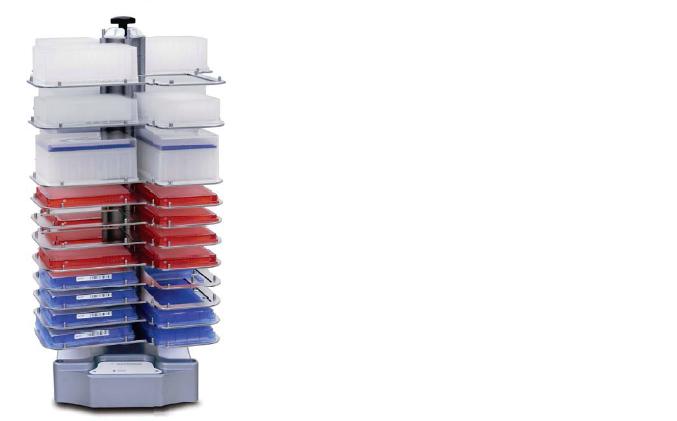
The Agilent Labware MiniHub from Agilent Automation Solutions is a rotating random-access device for presenting and storing SBS-format labware in laboratory automation systems.An efficient modular unit, the Labware MiniHub features user-configurable shelf spacing that easily accommodates a mix of microplates, tube racks, deep-well microplates, and pipette tip boxes while maintaining a compact footprint. The Agilent Labware MiniHub is designed with your applications in mind. Small but flexible, and safer than other alternatives, the Labware MiniHub solves all your room-temperature storage needs.
Labels: laboratory, drug discovery
Agilent Automation Solutions
Tuesday, 26 October 2010
Video demonstrates configurable direct drive robot
Agilent Automation Solutions has released an online streaming video that provides a visual insight into how its Agilent Direct Drive Robot (DDR), at the centre of a highly flexible BioCel System, advances high-throughput screening for drug discovery research and genomic applications.
The new 5-minute video (http://www.chem.agilent.com/en-US/Products/Instruments/automation/systems/ddr/Pages/DDR_video1.aspx) shows how the Agilent DDR is fast, precise, and designed with safety in mind. State-of-the-art direct drive technology reduces the number of moving parts, resulting in a robotic arm that has increased reliability and speed, moving smoothly with precision and accuracy. The innovative one-person, one-touch design of the Agilent DDR is shown to enable fast and easy robotic configuration teaching, minimizing setup time and the need for dedicated personnel.
Labels: laboratory, drug discovery
Agilent Automation Solutions
Tuesday, 28 September 2010
Lab automation and workflow
Agilent Automation Solutions has produced a guide to choosing the right automation instruments or instruments for your Next Generation Sequencing (NGS) workflow.
Next generation sequencing has revolutionized genomics, enabling entire genomes to be sequenced more efficiently than ever before. However, the typical NGS workflow is less revolutionary, with numerous manual steps and challenges that include cost, throughput, and variability.
Labels: laboratory, drug discovery
Agilent Automation Solutions,
Next Generation Sequencing
Friday, 17 September 2010
Introducing reliable automation into small- and large-scale applications
Agilent Automation Solutions has posted a recorded webinar to its website enabling scientists to learn techniques for introducing reliable automation into small- and large-scale applications ranging from single cells to core laboratory applications, thereby minimizing the potential for introduction of errors into the PCR process.
Polymerase chain reaction (PCR) remains one of the most widely used techniques in molecular biology for tumor characterization, pathogen identification, detection of genetic diseases and/or susceptibility, and, potentially, to predict drug responses.
Labels: laboratory, drug discovery
Agilent Automation Solutions
Thursday, 16 September 2010
Isolation of high yield gDNA
Agilent Automation Solutions has released an application note that demonstrates how the Agilent gDNA Isolation Workstation, utilizing the Invitrogen ChargeSwitch EasyPlex kit, provides the throughput, and walk-away time necessary to keep up with the demands of genomic applications.Efficient isolation of high-yield gDNA is an important step in high-throughput analysis of the genome. Isolating gDNA can be accomplished by a number of approaches. Automated liquid-handling workstations can be used to isolate gDNA in a reliable, repeatable, and contamination-free manner.
Labels: laboratory, drug discovery
Agilent Automation Solutions,
Agilent gDNA Isolation Workstation
Thursday, 2 September 2010
DNA purification and sequencing
An applications bulletin is available from Agilent Automation Solutions that describes an automated system that provides for quick and reliable DNA purification and sequencing
.
The demand for quick and reliable DNA sample preparation for sequencing has risen dramatically during recent years. The long and complex pipetting protocols needed for DNA preparation have been a challenge for many lab automation systems.
Labels: laboratory, drug discovery
Agilent Automation Solutions,
BioCel system
Wednesday, 1 September 2010
Complete automation of quantitative polymerase chain reaction assay
Agilent Automation Solutions has released a new application note that demonstrates how its Bravo Automated Liquid Handling Platform provides an effective way to automate setup of a variety of quantitative polymerase chain reaction (qPCR) assays.
qPCR assays have become widespread for detecting and measuring the abundance of specific genetic targets. Technologies developed to detect and monitor PCR product formation and accumulation include TaqMan and Molecular Beacons, which measure accumulation of PCR product-specific fluorescent probes. Another method involves measuring the increase of fluorescent DNA intercalating dyes such as SYBR Green.
Labels: laboratory, drug discovery
Agilent Automation Solutions,
Bravo Automated Liquid Handling Platform
Subscribe to:
Posts (Atom)